
Washington State's Educator-First Mortgage Broker
Rates and APRs shown are sample/average figures updated daily by Edge Home Finance for illustration purposes. Actual rate and APR depend on credit profile, loan amount, down payment, term, and lender fees. Click any product to pre-fill the calculator below. Not a commitment to lend. John P. Cobain · NMLS #374881 · Equal Housing Lender.
Update today's rates — enter as percentage (e.g. 6.750)
Rate editor login
Enter your admin password to update today's rates.
Payment Calculator
Click any rate above to auto-fill, or enter your own numbers.
Personalized Mortgage Experience
I've spent 30 years helping Washington State families buy homes — first-time buyers, veterans, self-employed borrowers, and everyone in between. My approach has always been the same: educate first, sell never. As a mortgage broker, I shop multiple lenders to find you the best rate and the right program for
your situation. If you're buying in Tacoma, Lakewood, Gig Harbor, Spokane, or anywhere across Washington State, let's have a real conversation — no pressure, no jargon.
The Home Loan Process
Mortgage Pre-Approval
Get pre-approved from one of our Loan Officers to see how much you can afford.
House Shopping
Work with a trusted Real Estate Agent to find a home you would like to move into.
Loan Application
Complete your home loan application to get the lending process started.
Don't take my word for it
Mortgage Programs
Mortgage programs built for Washington State buyers - from Tacoma and Gig Harbor to Spokane and everywhere in between.
Home Loan Options
Our experienced mortgage advisors will walk you through the best mortgage loan program that will fit your specific scenario.
Conventional Home Loans.
FHA Home Loans.
USDA Home Loans.
VA Home Loans.
Frequently Asked Questions
How often can I refinance my mortgage?
There's no set limit — you can refinance as many times as it makes financial sense to do so. What I
always tell people is that the right time to refinance is when the numbers genuinely work in your favor, not
just because rates moved a little. I'll help you run the break-even analysis so you know exactly what you'd
save and how long it takes to recoup closing costs. That's the only way to make a truly informed decision.
Can I buy a home if I don't have money for a down payment?
You might have more options than you think. VA loans allow zero down payment for eligible veterans and
active-duty service members. USDA loans offer zero down for buyers in qualifying rural and suburban areas
across Washington State — many communities around Tacoma, Spokane, and the Olympic Peninsula qualify. There are also Washington State down payment assistance programs that can cover some or all of your down payment on FHA and conventional loans. Let's look at what applies to your situation specifically.
How do I know which mortgage is right for me?
That's exactly the conversation I like to have before anything else. Every buyer is different — your credit,
your income, your down payment, your goals — and the right program depends on all of those factors
together. I specialize in VA loans, first-time homebuyer programs, FHA, USDA, jumbo, and Non-QM
financing, so I have a wide range of options to work with. My job is to lay out what's available, explain the real
differences, and let you make the call. No pressure either way.
How long will the loan process take?
A typical purchase loan takes around 30 days from application to closing, though it can move faster with
good preparation. VA loans have an additional appraisal step that can add a little time. USDA loans include a
secondary review by the USDA itself, which also extends the timeline slightly. I'll set honest expectations at
the start based on your specific loan type and keep both you and your realtor updated throughout — no one
should ever feel like they're in the dark about where things stand.
Will I qualify for a home loan?
The only real way to know is to have a conversation and look at your actual situation together. I've helped
a lot of buyers who came in thinking they couldn't qualify and walked away with a path forward. Credit,
income, down payment, employment history — there are a lot of variables, and sometimes one small
adjustment changes everything. I'll give you an honest assessment and if now isn't the right time, I'll tell you
that too, along with what it would take to get there.
Why do people refinance their mortgages?
The most common reasons are to lower their interest rate, reduce their monthly payment, or shorten their
loan term. Some homeowners refinance to access equity for home improvements or to consolidate debt.
Buyers who started with an FHA loan sometimes refinance into a conventional loan once they've built 20%
equity — which eliminates FHA mortgage insurance and can meaningfully lower their payment. Whatever the
reason, I'll help you run the numbers so the decision makes sense on paper before you commit to anything.
How much money will I have to pay upfront to buy a home?
It depends on the loan program and your situation. VA loans can be zero down for eligible veterans.
USDA loans are zero down in qualifying areas. FHA loans require as little as 3.5% down, and some
conventional programs go as low as 3%. On top of the down payment, you'll have closing costs — typically
2–3% of the loan amount, though some can be rolled in or covered by seller concessions. Down payment
assistance programs in Washington State can also help cover upfront costs for qualifying buyers. We'll look
at all of it together.
Can I get a mortgage after bankruptcy?
Yes — bankruptcy doesn't permanently close the door on homeownership. Each loan program has
defined waiting periods after a bankruptcy discharge. FHA typically requires two years after a Chapter 7. VA
loans are generally two years as well. Conventional loans are typically four years. The waiting periods after a
Chapter 13 can be shorter if you've been making payments consistently. Once you've cleared the waiting
period and rebuilt some credit, there's often a real path forward. Let's talk about where you are and what the
timeline looks like.
Should I lock my interest rate now or wait?
I track rates every day — multiple times a day, actually — because they move constantly based on
economic data, Fed decisions, and bond market activity. My honest answer is: if the rate available today
makes the payment work for your budget, locking now eliminates the risk of it going higher. Waiting is a
gamble. Rates can improve, but they can also move against you quickly. I'll give you my read on where
things are and what I'm seeing in the market, and then you make the call. That's what I'm here for.
Most Recent Blog Updates
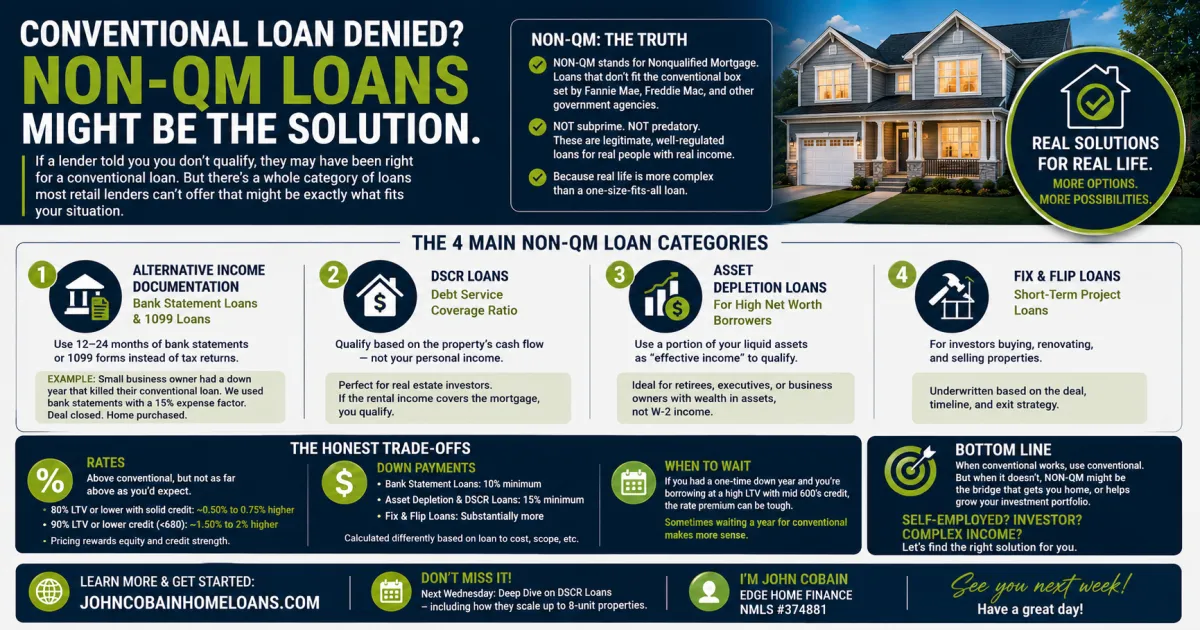
What Non QM Loans Are Who They Are For and the Honest Trade-Offs Every Borrower Should Understand
What Non QM Loans Are Who They Are For and the Honest Trade-Offs Every Borrower Should Understand
The Loan Category Most Retail Lenders Cannot Offer and What That Means for You
If a lender told you that you do not qualify they may have been telling the truth about a conventional loan. But conventional is not the only category and for a significant number of borrowers whose situations do not fit the standard framework it is not the right category either.
John Cobain at Edge Home Finance wants to introduce you to non QM lending because the myth surrounding it is outdated and the opportunity it represents for self-employed borrowers, real estate investors, and high-net-worth individuals is genuinely significant.
What Non QM Actually Is and What It Is Not
Non QM stands for non-qualified mortgage. The simplest definition is that it is the category of loans that does not fit the conventional box as defined by Fannie Mae, Freddie Mac, and other government regulatory agencies. Those agencies set the standard rules for what qualifies as a conforming loan. Anything outside that box is non QM.
The most important misconception to address immediately is that non QM is not subprime and it is not predatory. That angst exists in the market and it is outdated. These are legitimate well-regulated loan products built for borrowers whose situations do not fit the standard form not for borrowers who cannot actually afford a mortgage. Non QM exists because the real world is more complicated than a Fannie Mae qualification rubric and it gives legitimate borrowers the mortgage options they deserve.
Who Non QM Loans Are Actually For
John Cobain's non QM business splits roughly fifty-fifty between two main borrower groups.
Self-employed borrowers. Business owners, contractors, gig workers, and freelancers who have strong actual income but tax returns that do not reflect it because of legitimate business deductions. The small business owner who runs their taxes correctly ends up looking underqualified on paper despite generating real cash flow. Non QM was designed in part to solve exactly that problem.
Real estate investors. Buyers of rental properties whose personal W-2 matters less than the property's ability to generate cash flow. Traditional conventional loans limit investor property purchases. Non QM and specifically the DSCR category opens that up in ways that make scaling a real estate portfolio significantly more accessible.
Beyond those two primary groups non QM also serves high-net-worth borrowers whose wealth is concentrated in assets rather than income and fix and flip investors doing short-term project loans.
The Four Main Non QM Categories
Alternative income documentation includes bank statement loans and 1099 loans. Instead of tax returns the lender uses twelve to twenty-four months of business or personal bank statement deposits or the 1099 forms the borrower received. John recently worked with a small business owner who had a down year in 2025 that killed the conventional qualification. Using gross deposits with a fifteen percent expense factor on the bank statement program the deal closed and the home was purchased.
DSCR loans are built for real estate investors and qualify based on the property's cash flow rather than the borrower's personal income. If the rental income covers the mortgage payment that is the qualification. The investment property's performance is the underwriting story not the borrower's W-2. A deep dive on DSCR including how it scales up to eight-unit properties is coming in the next episode.
Asset depletion loans serve high-net-worth borrowers whose wealth is in liquid assets rather than regular income. This applies to retired executives, people who sold businesses, and individuals with substantial investment portfolios. A portion of the liquid assets is used as effective qualifying income.
Fix and flip loans are short-term project loans for investors buying, renovating, and selling properties. The underwriting focuses on the deal itself, the timeline, and the exit strategy rather than the borrower's income profile. Down payment requirements are higher and calculated differently based on loan to cost rather than loan to value.
The Honest Trade-Offs Worth Understanding
Non QM pricing runs above conventional rates but probably not as far above as most borrowers expect. At eighty percent loan to value or lower with solid credit the non QM rate premium is typically around a half to three quarters of a point above conventional. That is the realistic gap for well-positioned borrowers.
The nuance is important. If you are at ninety percent loan to value or your credit score is under 680 that premium can widen to one and a half or even two points above conventional non QM pricing. Non QM rewards equity and credit strength and the pricing reflects that.
Down payment minimums are higher than conventional across the board. Bank statement loans start at ten percent down. Asset depletion and DSCR loans typically require fifteen percent minimum. Fix and flip programs require substantially more depending on loan to cost calculations.
There are also situations where John tells clients to wait rather than pursue non QM. If you had a one-time down year, you are borrowing at a high loan to value, and your credit score is in the mid-600s the rate premium can get rough enough that waiting a year for conventional to become available makes more financial sense than locking into a high non QM rate today. When conventional works use conventional. When it does not non QM may be exactly the bridge that makes the purchase possible.
How to Access Non QM Products
Most retail lenders do not offer a wide range of non QM products. It is not a marketing pitch. It is how the system works. As a broker with over a hundred lender relationships John Cobain has access to non QM specialists that a retail loan officer or a bank simply cannot reach. That access is what makes it possible to match a borrower whose situation is outside the conventional box with the specific product that actually fits.
Visit johncobainhomeloans.com to find out which non QM category fits your situation. John Cobain at Edge Home Finance NMLS 374881 will walk through the options and identify the right path forward.
Sources
ConsumerFinancialProtectionBureau.gov
MortgageNewsDaily.com
NationalMortgageProfessional.com
Investopedia.com
FannieMae.com

Mortgage Calculator
See your total mortgage payments using the tool below.
| Year | Interest | Principal | Balance |
|---|