
Washington State's Educator-First Mortgage Broker
Rates and APRs shown are sample/average figures updated daily by Edge Home Finance for illustration purposes. Actual rate and APR depend on credit profile, loan amount, down payment, term, and lender fees. Click any product to pre-fill the calculator below. Not a commitment to lend. John P. Cobain · NMLS #374881 · Equal Housing Lender.
Update today's rates — enter as percentage (e.g. 6.750)
Rate editor login
Enter your admin password to update today's rates.
Payment Calculator
Click any rate above to auto-fill, or enter your own numbers.
Personalized Mortgage Experience
I've spent 30 years helping Washington State families buy homes — first-time buyers, veterans, self-employed borrowers, and everyone in between. My approach has always been the same: educate first, sell never. As a mortgage broker, I shop multiple lenders to find you the best rate and the right program for
your situation. If you're buying in Tacoma, Lakewood, Gig Harbor, Spokane, or anywhere across Washington State, let's have a real conversation — no pressure, no jargon.
The Home Loan Process
Mortgage Pre-Approval
Get pre-approved from one of our Loan Officers to see how much you can afford.
House Shopping
Work with a trusted Real Estate Agent to find a home you would like to move into.
Loan Application
Complete your home loan application to get the lending process started.
Don't take my word for it
Mortgage Programs
Mortgage programs built for Washington State buyers - from Tacoma and Gig Harbor to Spokane and everywhere in between.
Home Loan Options
Our experienced mortgage advisors will walk you through the best mortgage loan program that will fit your specific scenario.
Conventional Home Loans.
FHA Home Loans.
USDA Home Loans.
VA Home Loans.
Frequently Asked Questions
How often can I refinance my mortgage?
There's no set limit — you can refinance as many times as it makes financial sense to do so. What I
always tell people is that the right time to refinance is when the numbers genuinely work in your favor, not
just because rates moved a little. I'll help you run the break-even analysis so you know exactly what you'd
save and how long it takes to recoup closing costs. That's the only way to make a truly informed decision.
Can I buy a home if I don't have money for a down payment?
You might have more options than you think. VA loans allow zero down payment for eligible veterans and
active-duty service members. USDA loans offer zero down for buyers in qualifying rural and suburban areas
across Washington State — many communities around Tacoma, Spokane, and the Olympic Peninsula qualify. There are also Washington State down payment assistance programs that can cover some or all of your down payment on FHA and conventional loans. Let's look at what applies to your situation specifically.
How do I know which mortgage is right for me?
That's exactly the conversation I like to have before anything else. Every buyer is different — your credit,
your income, your down payment, your goals — and the right program depends on all of those factors
together. I specialize in VA loans, first-time homebuyer programs, FHA, USDA, jumbo, and Non-QM
financing, so I have a wide range of options to work with. My job is to lay out what's available, explain the real
differences, and let you make the call. No pressure either way.
How long will the loan process take?
A typical purchase loan takes around 30 days from application to closing, though it can move faster with
good preparation. VA loans have an additional appraisal step that can add a little time. USDA loans include a
secondary review by the USDA itself, which also extends the timeline slightly. I'll set honest expectations at
the start based on your specific loan type and keep both you and your realtor updated throughout — no one
should ever feel like they're in the dark about where things stand.
Will I qualify for a home loan?
The only real way to know is to have a conversation and look at your actual situation together. I've helped
a lot of buyers who came in thinking they couldn't qualify and walked away with a path forward. Credit,
income, down payment, employment history — there are a lot of variables, and sometimes one small
adjustment changes everything. I'll give you an honest assessment and if now isn't the right time, I'll tell you
that too, along with what it would take to get there.
Why do people refinance their mortgages?
The most common reasons are to lower their interest rate, reduce their monthly payment, or shorten their
loan term. Some homeowners refinance to access equity for home improvements or to consolidate debt.
Buyers who started with an FHA loan sometimes refinance into a conventional loan once they've built 20%
equity — which eliminates FHA mortgage insurance and can meaningfully lower their payment. Whatever the
reason, I'll help you run the numbers so the decision makes sense on paper before you commit to anything.
How much money will I have to pay upfront to buy a home?
It depends on the loan program and your situation. VA loans can be zero down for eligible veterans.
USDA loans are zero down in qualifying areas. FHA loans require as little as 3.5% down, and some
conventional programs go as low as 3%. On top of the down payment, you'll have closing costs — typically
2–3% of the loan amount, though some can be rolled in or covered by seller concessions. Down payment
assistance programs in Washington State can also help cover upfront costs for qualifying buyers. We'll look
at all of it together.
Can I get a mortgage after bankruptcy?
Yes — bankruptcy doesn't permanently close the door on homeownership. Each loan program has
defined waiting periods after a bankruptcy discharge. FHA typically requires two years after a Chapter 7. VA
loans are generally two years as well. Conventional loans are typically four years. The waiting periods after a
Chapter 13 can be shorter if you've been making payments consistently. Once you've cleared the waiting
period and rebuilt some credit, there's often a real path forward. Let's talk about where you are and what the
timeline looks like.
Should I lock my interest rate now or wait?
I track rates every day — multiple times a day, actually — because they move constantly based on
economic data, Fed decisions, and bond market activity. My honest answer is: if the rate available today
makes the payment work for your budget, locking now eliminates the risk of it going higher. Waiting is a
gamble. Rates can improve, but they can also move against you quickly. I'll give you my read on where
things are and what I'm seeing in the market, and then you make the call. That's what I'm here for.
Most Recent Blog Updates
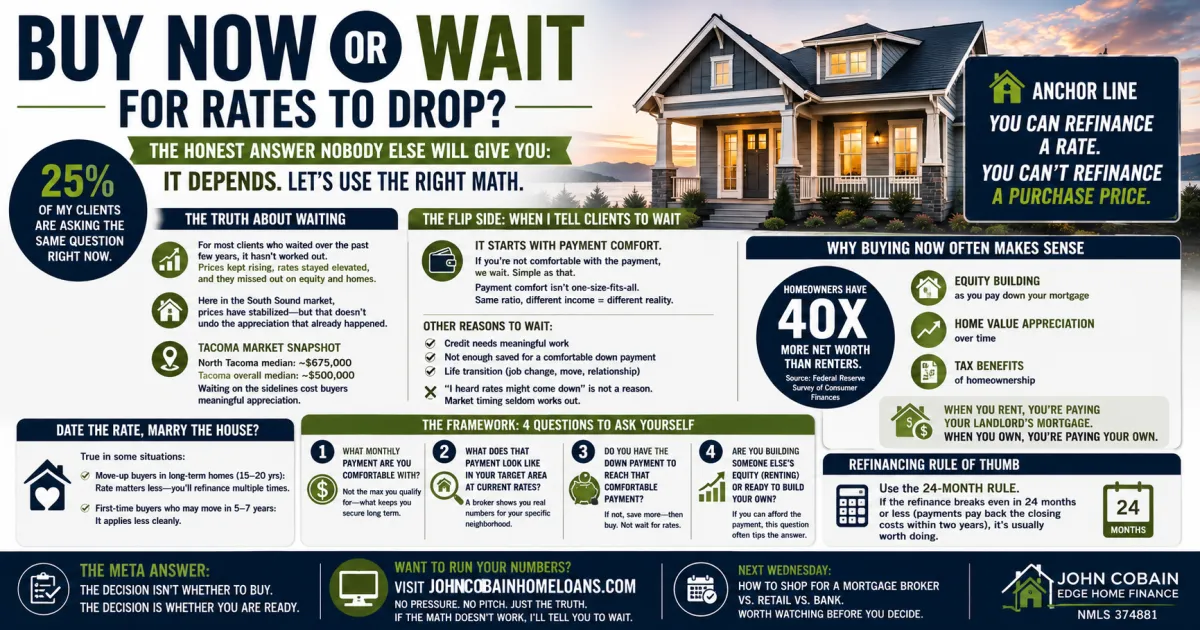
Should You Buy Now or Wait for Rates to Drop and Here Is the Math Based Framework to Find Your Answer
The Honest Answer Nobody Else Will Give You
About a quarter of John Cobain's clients at Edge Home Finance are asking the same question right now. Should I buy now or wait for rates to drop?
His answer is not what most people expect. It depends. Not in a vague or uncommitted way. In a specific math-based way that produces a real answer for each individual situation rather than a generic recommendation that may or may not apply to where someone actually stands.
What Waiting Has Actually Produced for Most Clients
The honest starting point is what has happened to clients who chose to wait over the past few years. For most of them it has not worked out. Home prices kept appreciating. Rates stayed elevated. They missed out on equity growth and on specific homes they wanted that are no longer available at prior prices.
In the South Sound market specifically prices have stabilized recently but that stabilization does not undo the appreciation that already occurred. North Tacoma is trading at a median price around $675,000. Tacoma overall is closer to $500,000. Buyers who were on the sidelines watched the North End appreciate meaningfully year over year while they waited for conditions that never aligned the way they hoped.
John did have one client who waited about a year and found an absolute bargain of a home that would not have been on the market when he was originally looking. That outcome is possible. But the unpredictability works in both directions. You never know when the right property is going to show up. And the anchor line worth remembering is this. You can refinance a rate. You cannot refinance a purchase price.
When John Actually Tells Clients to Wait
John is direct about the legitimate cases for waiting because his credibility depends on not giving everyone the same answer regardless of their situation.
Payment comfort is the primary framework. If a client is not comfortable with the payment the answer is to wait. Period. That is not a complex calculation. It is the foundational question that everything else follows from.
Payment comfort is not the same as debt-to-income ratio and this distinction matters more than most buyers realize. Someone at 45 percent back-end DTI on a $15,000 monthly income has significantly more disposable income left over than someone at the same 45 percent DTI on $7,500 monthly income. Same ratio. Very different realities. John looks at what is actually left after the payment not just the ratio the underwriting guidelines produce.
Other legitimate reasons to wait include credit that needs meaningful work, insufficient savings for a comfortable down payment, and life transitions such as job changes, anticipated moves, or relationship changes that make a long-term commitment premature. What is not a legitimate reason by itself is the idea that rates might come down. Market timing seldom works out in the buyer's favor.
The Wealth Building Case for Buying When You Are Ready
For clients who are financially ready but nervous about current rates John makes the wealth building argument and the numbers behind it are not subtle.
According to the most recent Federal Reserve Survey of Consumer Finances the typical homeowner has approximately forty times more net worth than the typical renter. Forty times. That is not a marginal difference. That is a life-changing gap that compounds over decades through equity building as the mortgage is paid down, home value appreciation over time, and the tax benefits that come with ownership.
When you rent you are paying your landlord's mortgage. When you own you are paying your own. That distinction, repeated month after month and year after year, is what produces the forty times net worth differential.
The Date the Rate Marry the House Framework and When It Applies
The phrase date the rate and marry the house has been used enough that it borders on cliche. But it is still true in specific situations and worth understanding with more precision than the shorthand allows.
For move-up buyers looking at a long-term home they plan to stay in for fifteen or twenty years the current rate matters relatively less because they will refinance multiple times over that horizon. For first-time buyers who might want to move in five to seven years the phrase applies less cleanly because they may not be in the home long enough to capture the full benefit of a future refinance.
The situation determines how much the current rate should weigh in the decision.
The Four-Question Framework John Actually Uses
Question one is what monthly payment are you comfortable with. Not what is the maximum qualification. What is comfortable enough to handle a bad month, a car repair, a job change, and still stay in the home long term.
Question two is what does that payment look like in your target area at current rates. This is where working with a broker produces real numbers rather than internet estimates. Specific neighborhood, specific down payment level, today's rate. Actual numbers to work with.
Question three is whether you have the down payment to reach that comfortable payment level. If not the real answer is not to wait for rates to fall. The real answer is to save the down payment. That is the actual obstacle.
Question four is whether you are currently building someone else's equity by renting or whether you are ready to start building your own. For clients who can genuinely afford the payment this question usually tilts the decision.
The 24 Month Refinance Rule
For clients thinking ahead to when rates eventually improve John uses a specific and concrete benchmark for evaluating a future refinance. If the refinance breaks even within 24 months meaning the payment savings pay back the closing costs of the refinance within two years it is generally worth doing. That is a number to hold onto for later rather than a concept to think about abstractly.
The Meta Answer
The decision is not really whether to buy. The decision is whether you are ready. If the payment is comfortable, the down payment is in place, and the life circumstances support a long-term commitment the math almost always points toward buying now rather than waiting for conditions that may shift in any direction.
If you want to run your specific numbers visit johncobainhomeloans.com. John Cobain at Edge Home Finance will walk through the framework with your actual situation. If the math does not work he will tell you to wait. NMLS 374881.
Sources
FederalReserve.gov
MortgageNewsDaily.com
ConsumerFinancialProtectionBureau.gov
NAR.realtor
Investopedia.com

Mortgage Calculator
See your total mortgage payments using the tool below.
| Year | Interest | Principal | Balance |
|---|